UkraineDigiTrans project: Ukrainian teachers share digital skills at their home universities
The UkraineDigiTrans project, coordinated by Laurea, supports Ukrainian medical universities in their digital transformation.
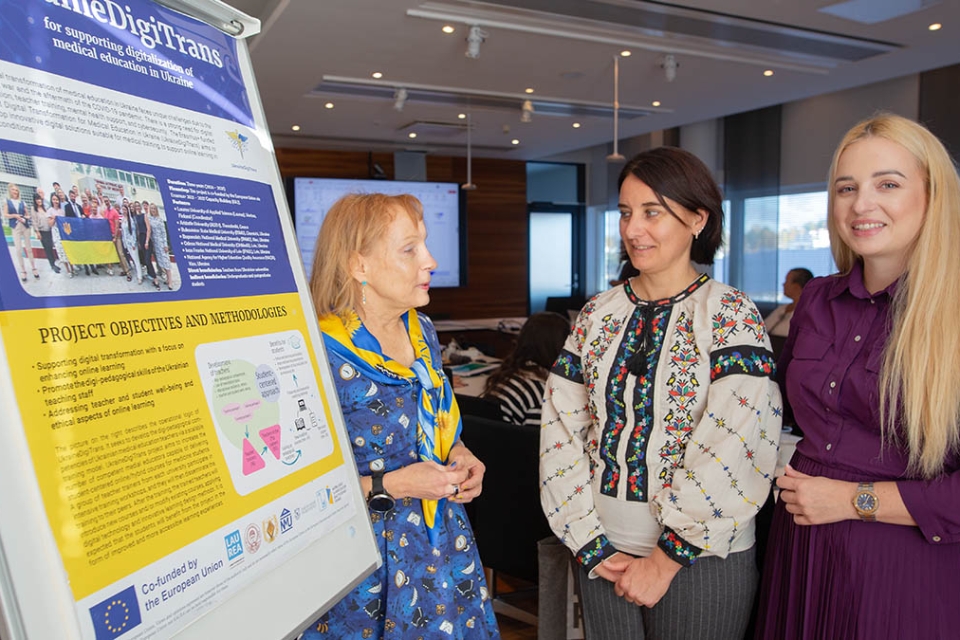
"As teachers, you are building Ukraine's future." With these words, Mykhailo Vydoynyk, Ukraine's ambassador to Finland, thanked the participants of the UkraineDigiTrans project led by Laurea when the project's final workshop week at Laurea came to an end in October.
Next, the project participants from Ukrainian medical universities will replicate the training and continue to develop the courses at their home country, utilizing the lessons learned from the project. Ukrainian teachers will train their colleagues and pass on their digi-pedagogical skills, as well as produce new online courses. The goal of the next phase of the project is for the partner universities to reform existing studies from pedagogical and technological perspectives and to produce new courses and microcourses.
Four Ukrainian universities take part in the project
The Digital Transformation for Medical Education in Ukraine (UkraineDigiTrans) project, funded by the EU's Erasmus+ program and coordinated by Laurea, was launched at the end of 2024. So far, three workshop weeks have been organized as part of the project: two at Laurea and one in Greece by the project partner from Aristotle University of Thessaloniki.
“We had another very rewarding week at Laurea”, summarize Iryna Popova and Ievgeniia Burlaka from Ukraine, reflecting on the October workshop week.
Popova works at Bukovinian State Medical University in Chernivtsi, western Ukraine, and Burlaka at Bogomolets National Medical University in Kyiv. The two other Ukrainian universities participating in the UkraineDigiTrans project are Ivan Franko University in Lviv and Odessa Medical University.
The next step is to train colleagues in Ukraine
During the workshop week in October, participants learned from the Finnish and Greek experts about topics such as the use of artificial intelligence, simulation pedagogy, and the production of educational media such as videos and podcasts.
“We have learned a lot about different digital tools and applications that we can use, for example, in teaching clinical situations”, says Ievgeniia Burlaka.
“The next phase of the project will be an important one, as we will be taking what we have learned back to our home universities and training our colleagues to develop digital studies. I believe it will be easy to get them excited about it too”, she continues.
When necessary, teaching continues in bomb shelters
The workshop weeks have also provided Ukrainian teachers with a rare and extremely valuable opportunity to meet face-to-face not only with project participants from Finland and Greece, but also with their colleagues from Ukraine. In a country at war, there has been no opportunity for meetings and exchanges of ideas.
War is present in the everyday lives of all Ukrainians, and one of the topics of the October workshop week was resilience. The war, which has been going on for four years now, also affects teaching:
“The war affects all of us – teachers and students alike – but it is important to stay strong”, says Iryna Popova.
“It is really important that we are able to create as safe an environment as possible for our students. When the alarm sounds, we move to bomb shelters, but teaching continues nonetheless.“
More information:
- Tuija Marstio
- Senior Lecturer
- Tuija.Marstio@laurea.fi
- Tel (09) 8868 7948